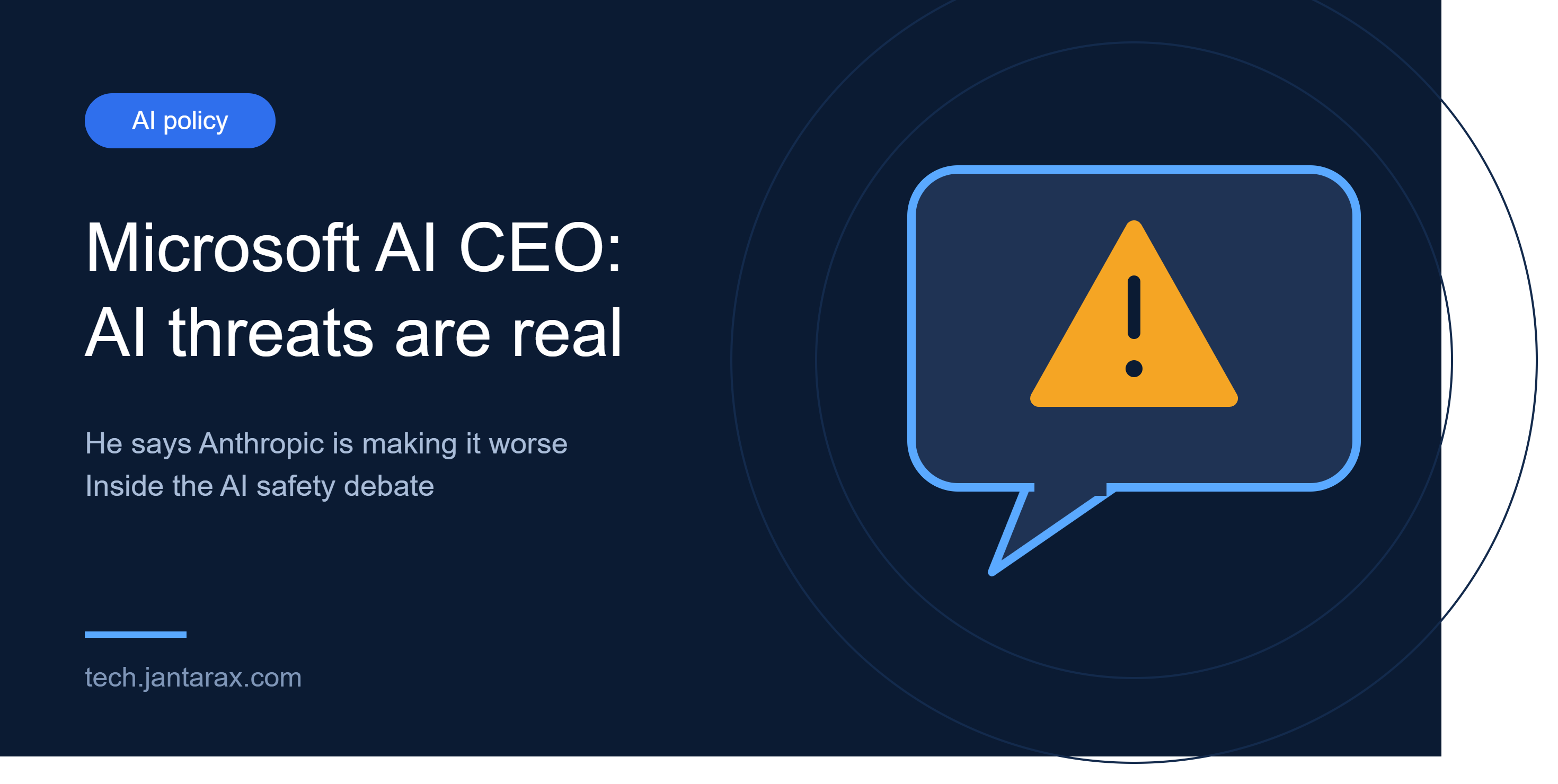
Mustafa Suleyman, the CEO of Microsoft AI, has added a sharp voice to the debate over AI safety. In a recent podcast interview, he said the threats posed by artificial intelligence are real, and he pointed to Anthropic as a company making the problem worse.
His comments land at a tense time. Tech leaders, lawmakers, and the public are all asking how fast AI should move and who should set the rules. Here is what Suleyman said, why it matters, and what could come next. For more coverage like this, visit our Policy and Technology sections at Jantarax Tech.
What Did Suleyman Say?
During the podcast, Suleyman made the case for stronger AI regulation. His core argument is that AI technology has moved faster than the rules and safety measures needed to manage it. That gap, he said, creates potential risks for society.
This is not a fringe view. Many people in the industry share the concern that AI development is racing ahead of the safeguards around it. What made Suleyman’s remarks stand out was that he named a specific company.
Why Did He Single Out Anthropic?
Suleyman specifically mentioned Anthropic, a company widely known for its focus on AI safety. He suggested that its approach may be contributing to the difficulty of regulating AI effectively.
The source material does not spell out exactly how he believes Anthropic is making things worse, so it is best to treat this as his opinion, not an established fact. It is also worth noting that Anthropic’s own response is not part of the reporting. Readers should look for any statement from the company before drawing conclusions.
Still, the comment raises a bigger question: what responsibilities do AI developers carry, even those that put safety at the center of their work?
The Wider AI Safety Debate
Suleyman’s remarks reflect a broader worry about unchecked AI development and its potential to cause harm. The conversation has gained momentum as different groups weigh in:
- Tech leaders, who often disagree on how much regulation is needed.
- Policymakers, who are trying to write rules for a fast-moving field.
- The public, which is increasingly aware of how AI affects jobs, privacy, and security.
Opinions vary widely. Some leaders argue that companies should handle safety themselves, as seen in Nvidia CEO Jensen Huang’s argument against AI regulation. Others, like Suleyman, say stronger rules are urgently needed. Both sides agree the stakes are high.
Where Do AI Companies Fit In?
Companies building AI are not just bystanders. They decide how powerful their models are, how they are released, and what safeguards come with them. That is why public criticism between rival firms draws attention.
At the same time, AI is also being used to improve security. Anthropic, for example, recently launched a free AI vulnerability scanner for open-source projects, which shows that the same technology can help find and fix software flaws. Real-world security failures remain a concern, as in the Revolut data breach caused by fake government requests. You can follow more stories like these in our Cybersecurity section.
What Happens Next?
As the discussion over AI regulation continues, more tech leaders are likely to weigh in. Several outcomes are possible:
- More public debate between companies about what responsible AI looks like.
- Closer collaboration between AI firms and regulators to build workable frameworks.
- Stronger calls for rules that cover how AI is built, tested, and deployed.
The industry may see growing pressure to agree on shared standards, rather than leaving each company to set its own.
What Does This Mean for Everyday Users?
Most people will not feel these debates directly, but the outcome affects the tools they use. Strong safety rules could mean more reliable and transparent AI products. Weak or unclear rules could leave users exposed to errors, misuse, or privacy risks.
In the meantime, it helps to use AI tools thoughtfully:
- Avoid sharing sensitive personal or financial details with AI chatbots.
- Double-check important information instead of trusting answers blindly.
- Read privacy settings and understand how your data is used.
Frequently Asked Questions
Who is Mustafa Suleyman?
He is the CEO of Microsoft AI.
What did he say about AI?
He said AI threats are real and that technology has advanced faster than the safety measures needed to control it.
Why did he mention Anthropic?
He suggested Anthropic’s approach may be adding to the challenges of regulating AI. This is his view, and the company’s response is not included in the source material.
Will AI regulation change soon?
Discussions are ongoing, and more calls for collaboration between companies and regulators are expected.
Conclusion
Suleyman’s comments highlight the urgent need for a thorough approach to AI safety and regulation. As the technology evolves, both developers and regulators share the responsibility to make sure AI serves the public good without compromising safety.
For more updates, learn about Jantarax Tech or contact our team with tips and feedback.
- artificial intelligence
- AI safety
- AI regulation
- tech policy
- tech news
- Microsoft AI CEO AI threats
- Mustafa Suleyman
- Microsoft AI
- Anthropic
- AI threats
- AI ethics