Doctors and nurses did not train for years to spend their evenings on paperwork. Yet for many clinicians, forms, records, insurance checks, and approvals take up a huge share of the week. Google Cloud wants to change that. On Tuesday, November 10, 2026, it launched Gemini for healthcare, a version of its AI agent for providers and payers in clinical and administrative settings. The goal is to pull scattered clinical data together and automate the workflows that surround patient care.
This guide explains what the platform does, how it works, who is using it, and what to watch before getting too excited. For more AI coverage, explore our Artificial Intelligence and Technology sections at Jantarax Tech.
What Problem Is Gemini for Healthcare Trying to Solve?
Healthcare runs on information, but that information is often trapped. Patient history, coverage guidelines, and administrative data stay locked in isolated systems, forcing teams to use patchwork solutions. Staff must jump between them, copy details by hand, and hope nothing gets missed.
Google Cloud CEO Thomas Kurian has framed the challenge as friction, not a lack of information, saying the hard part is making data actionable across a highly regulated ecosystem. That is the gap Gemini for healthcare is built to close.
The problem also has a human cost. When administrative work piles up, clinicians stay late, patients wait longer, and burnout grows.
The Numbers Behind the Burnout
Two statistics help explain why this launch matters:
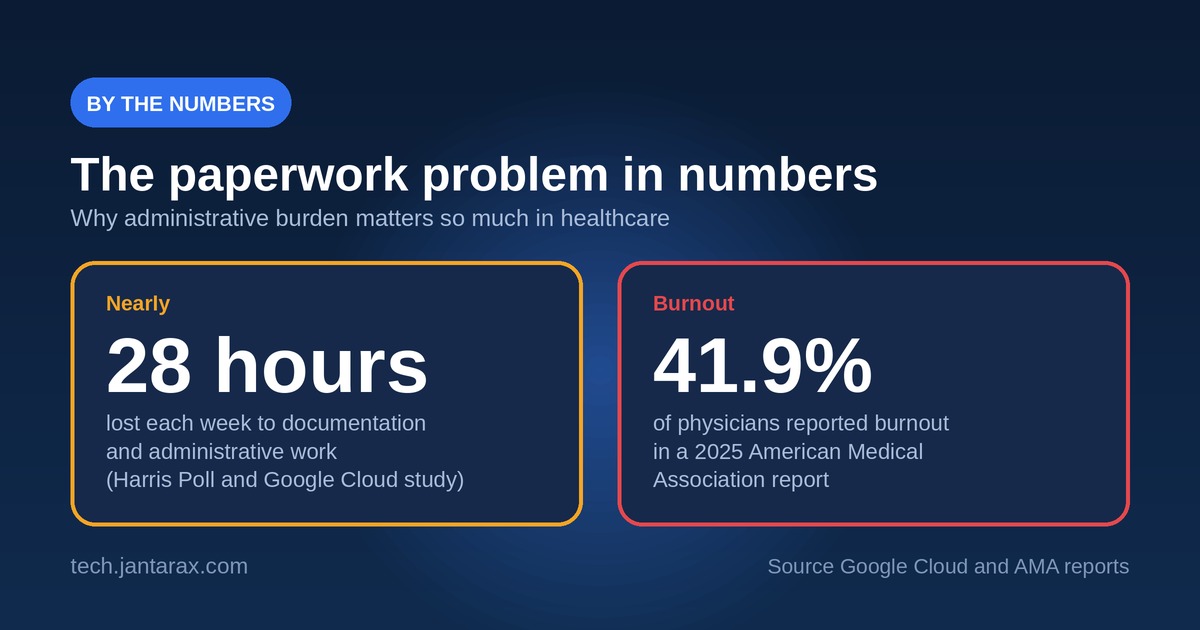
- Clinicians lose nearly 28 hours each week to clinical documentation and administrative requirements, according to a study from The Harris Poll and Google Cloud.
- A 2025 American Medical Association report found burnout among 41.9 percent of physicians.
Note that the first figure comes from a study Google took part in, so treat it as one data point, not a universal fact. Still, many healthcare surveys point in the same direction. Administrative burden is a major reason people leave clinical work or reduce their hours.
How Gemini for Healthcare Works
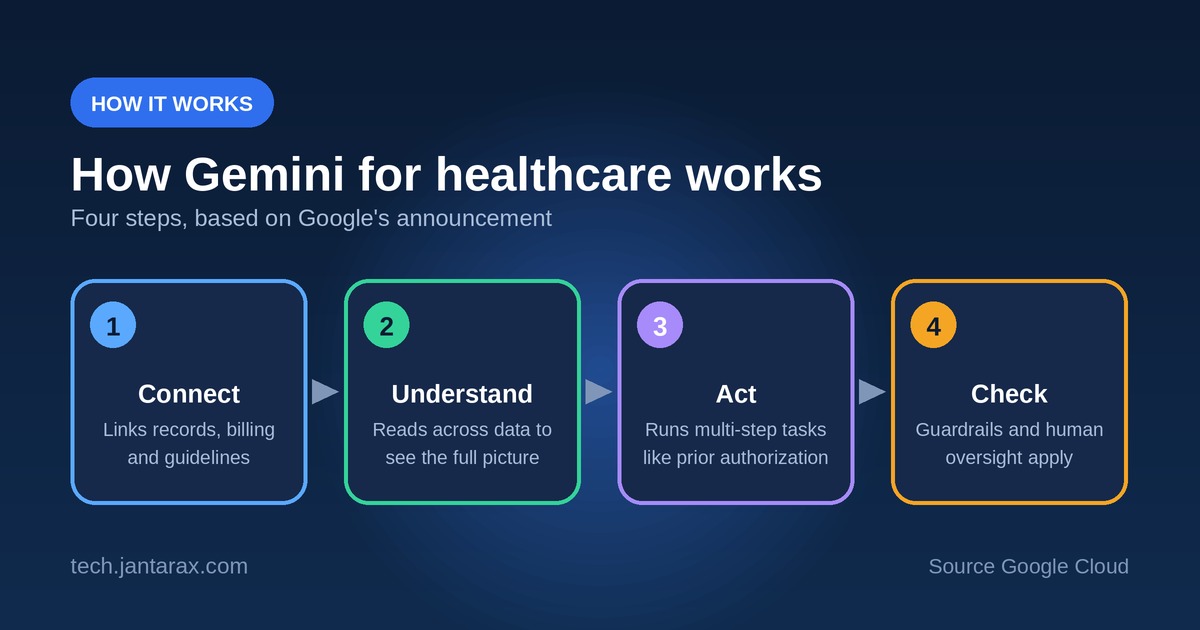
The platform is not a standalone chatbot. It extends Google’s Gemini agent framework with data connectivity, governance, and orchestration tuned for the sector.
In simple terms, Gemini for healthcare works in four steps:
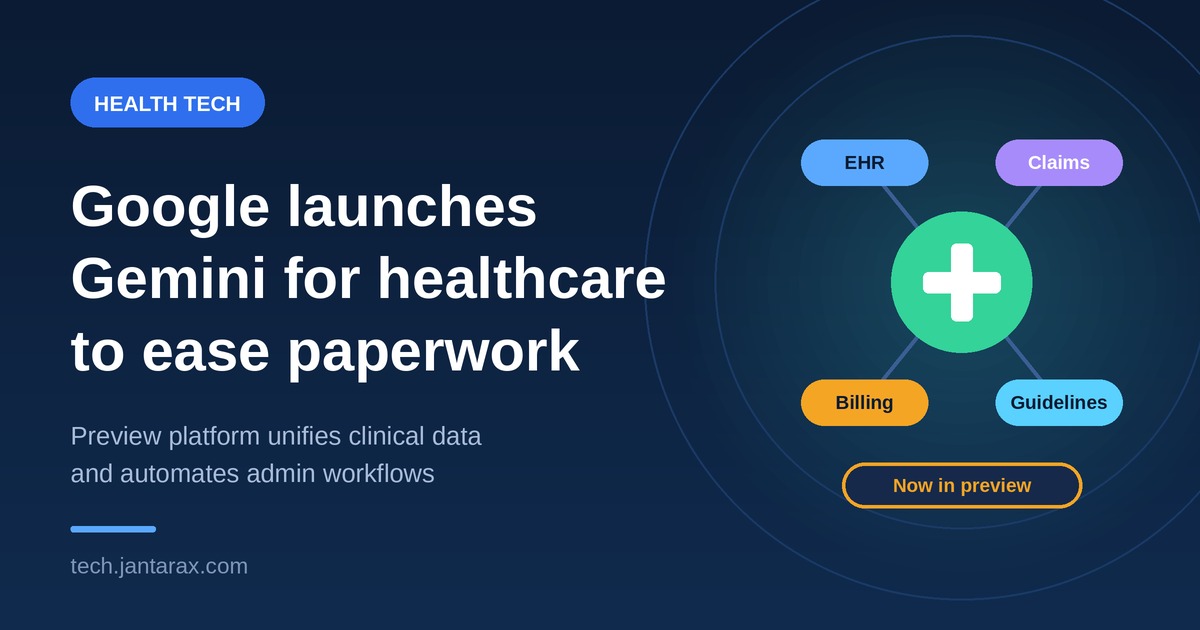
- Connect. It brings together information from electronic health records, billing platforms, clinical guidelines, and Medicare datasets through connectors to existing third-party systems.
- Understand. It reads across that information to build a picture of what is happening with a patient or a claim.
- Act. It orchestrates complex, multi-step workflows such as medical records synthesis and prior authorization review.
- Check. Work happens within defined guardrails and with appropriate human oversight. blog
Google says the platform connects to a healthcare organization’s electronic health record, claims workflows, and other systems to surface patient records, prepare paperwork, and check insurance details. It also connects workflows across Google Workspace, Microsoft 365, ServiceNow, and industry platforms like Salesforce’s agentic Health Cloud.
Smart routing is another feature. It sends high-volume administrative tasks to fast, low-cost models and reserves complex analysis for high-reasoning models. That approach can help control costs and speed.
Why Connecting Systems Matters
Interoperability, the ability of different systems to share information, has been a long-running goal in healthcare. Many hospitals run electronic health records from one vendor, billing software from another, and separate tools for insurers. When these do not talk to each other, staff become the bridge. They re-enter data, search several screens, and phone other offices to confirm details.
Connecting those systems can reduce that manual work and cut the chance of missing information. It can also make audits and reviews easier, since the source of each detail is easier to trace. This is why many healthcare leaders see data integration as a foundation for any useful AI.
What Can Gemini for Healthcare Do?
Based on Google’s announcement and news coverage, the platform focuses on administrative and operational tasks:
For providers (hospitals and clinics)
- Pull together records from different systems into a summary.
- Prepare pre-visit information.
- Draft and organize paperwork.
- Help with clinical chart summaries for reviews and appeals.
For payers (health plans and insurers)
- Review coverage guidelines.
- Support eligibility checks and prior authorization reviews.
- Streamline revenue cycle and coverage workflows.
For both
- Let organizations build custom workflow “skills.”
- Connect to outside tools and data through standard connectors.
An important point is what it is not. Coverage notes that it is used mainly to improve workflow efficiency, rather than to diagnose or advise treatment at the point of care.
Who Is Using Gemini for Healthcare So Far?
The platform is in preview, and Google lined up a long list of early users. Launch customers include Blue Cross Blue Shield of Massachusetts, Hartford HealthCare, HCA Healthcare, Highmark Health, Northwell Health, Optum, and Stanford School of Medicine. The American Society of Clinical Oncology is among the contributors.
A wider ecosystem is plugging into the platform too:
- Suki offers ambient clinical intelligence, which helps with documentation.
- UiPath automates clinical chart summaries and pulls out citation-backed evidence for utilization reviews and appeals.
- Alteryx helps teams turn expertise into automated analytics workflows.
- Synthpop automates back-office work and patient-facing journey flows.
- ServiceNow and Salesforce link departments for coordination.
- Quantiphi, IMO Health, and Keragon add clinical knowledge management and workflow automation.
Some big names were already using Google’s AI before this launch. For example, CVS Health’s Health100 platform uses Gemini features for consumer engagement.
Safety, Privacy and Human Oversight
Health data is among the most sensitive information there is. Any AI that touches it raises serious questions. Google says Gemini for healthcare includes governance tools, works within defined guardrails, and keeps humans in the loop where appropriate.
Questions that healthcare organizations will likely ask include:
- Where is the data stored and processed? Does patient data leave the organization’s environment?
- Who can see what? Are access controls detailed enough for different roles?
- How are decisions logged? Can staff trace how the AI reached a result?
- How are errors caught? What happens if the AI misreads a record or summarizes it wrongly?
- How does it meet legal rules? Healthcare data is regulated, and rules differ by country.
These are general questions, not details from Google’s announcement. If you work in healthcare IT, ask vendors for specifics and involve your privacy and security teams. Our Cybersecurity section covers how data breaches happen and how to reduce the risk, a topic that matters even more when health records are involved.
What It Could Mean for Patients
Patients will rarely see the software directly. But if Gemini for healthcare works as promised, they could notice:
- Shorter waits for approvals and referrals.
- Fewer repeated questions, because records are better connected.
- More face time with clinicians who spend less time on forms.
- Faster insurance answers, since coverage checks are automated.
Those benefits are possible, not guaranteed. They depend on how well the platform fits into real hospitals and how carefully people use it.
Limits and Open Questions
It is worth staying realistic. A few caveats stand out:
It is in preview. Gemini for healthcare is still being tested, and features may change.
No measured results yet. One analysis of the launch notes that the announcement describes workflow orchestration, not a measured reduction in care-team workload. The claim about reducing burnout is a goal, not a proven result.
Integration is hard. Hospitals use many different systems, often old ones. The platform’s value depends on how well it connects to them.
Accuracy matters. Summaries and paperwork must be correct. Mistakes in health records can have real consequences, so human review is essential.
Cost and vendor choice. Organizations will weigh the price against alternatives, including similar healthcare platforms from other big tech companies.
Trust. Clinicians and patients need to feel comfortable with AI handling sensitive information.
How It Compares With Other Healthcare AI
Google is not alone. It is the latest big tech company to launch a healthcare-specific agentic AI platform, and healthcare has invested heavily in agentic AI to ease administrative burden, such as prior authorization and revenue cycle management. What Google highlights is its focus on connecting clinical, operational, and administrative systems in one place, plus its network of partners.
The same trend is spreading beyond healthcare. For example, Anthropic recently launched an AI feature that joins video calls to turn discussions into plans and tasks, showing how AI agents are moving into everyday office work. The wider debate over how such tools should be governed continues, as shown in our brief history of AI executives calling for regulation.
What Healthcare Organizations Should Ask Before Adopting
If you are evaluating a platform like this, a few practical questions can help:
- Which problems do we want to solve first? Pick one or two high-burden workflows.
- Which of our systems must it connect to? Check compatibility early.
- What does the pilot measure? Define success, such as hours saved or faster approvals.
- Who reviews the AI’s work? Name responsible people.
- How do we handle errors? Plan how to report and fix them.
- What are the security and privacy controls? Review them with your compliance team.
- What is the total cost? Include setup, training, and usage fees.
- How will staff be trained? Tools only help if people trust and understand them.
What Happens Next?
As Google Cloud rolls out Gemini for healthcare, more organizations are likely to test it in pilots. Its success will depend on how well it works with existing systems and whether it can actually reduce administrative burdens. Things to watch include:
- Real-world results from early customers, such as time saved and error rates.
- Wider availability beyond the US preview.
- New partners and integrations.
- Pricing and packaging.
- Regulatory and privacy guidance for AI in healthcare.
- Responses from competitors in cloud and healthcare technology.
Frequently Asked Questions
What is this new Google Cloud platform?
It is a healthcare-focused agentic AI solution that unifies clinical, operational, and administrative systems and automates multi-step workflows.
When was it announced?
On Tuesday, November 10, 2026.
Is it available now?
It is launching in preview, so access is limited at first.
Does it diagnose patients?
No. Coverage describes it as focused on administrative and operational workflows, not diagnosis or treatment.
Who are the launch customers?
They include Blue Cross Blue Shield of Massachusetts, Hartford HealthCare, HCA Healthcare, Highmark Health, Northwell Health, Optum, and Stanford School of Medicine.
What data does it connect to?
Electronic health records, billing platforms, clinical guidelines, claims workflows, and Medicare datasets, among others.
Will it reduce burnout?
That is Google’s goal. Measured results have not been published yet.
Are humans still involved?
Google says workflows run within guardrails and with human oversight where appropriate.
Conclusion
Gemini for healthcare is a serious attempt to tackle one of healthcare’s biggest hidden problems, the paperwork that crowds out patient care. By connecting scattered systems and automating multi-step tasks, Google hopes to ease administrative pressure and improve efficiency. The promise is real, but so are the open questions about accuracy, privacy, cost, and results. The coming months of pilots will show whether the platform delivers.
For more updates, learn about Jantarax Tech or contact our team with tips and feedback.
- tech news
- agentic AI
- Gemini for healthcare
- Google Cloud
- healthcare AI
- clinical workflows
- administrative burnout
- prior authorization
- electronic health records
- health tech