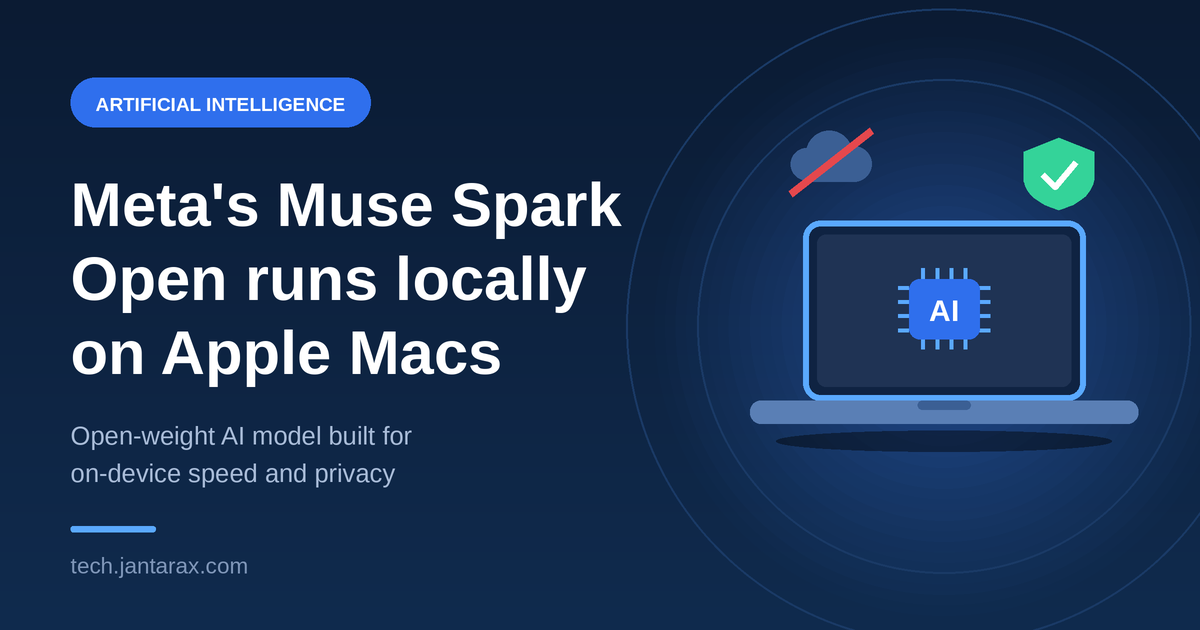
Meta has announced a new AI model called Muse Spark Open, designed to run locally on Macs with Apple silicon. The launch reflects a notable collaboration between Meta and Apple and points to a bigger trend: more AI running on your own computer instead of in the cloud.
Here is a simple guide to what was announced, why it matters, and what to watch next. For more stories like this, explore our Artificial Intelligence and Technology sections at Jantarax Tech.
What Is Muse Spark Open?
Muse Spark Open is Meta’s latest AI model. Its main feature is that it can run locally, directly on a Mac with Apple silicon, instead of sending your requests to a remote server.
Apple silicon refers to the chips Apple designs for its Macs, such as the M-series. The announcement says Meta aims to use the processing power of these chips to deliver a smoother AI experience on personal computers.
What Does “Open-Weight” Mean?
An open-weight model is one whose trained “weights” are shared publicly. Weights are the numbers that make up the model’s learned knowledge. When they are available, developers can:
- Customize the model for a specific job.
- Optimize it to run faster or use less memory.
- Build tools on top of it without starting from scratch.
Open-weight is not always the same as fully open source, since licenses and rules can differ. Check the official terms for details on how Muse Spark Open can be used.
Why Does Running AI Locally Matter?
Most popular AI tools work through the cloud. Your request goes to a data center, gets processed, and the answer comes back. Running a model on your own device changes that in a few ways.
Better privacy. When processing happens on your Mac, your data does not need to leave the device. That can be reassuring for private documents, work files, and personal notes. For context on why data protection matters, see our story on the Revolut data breach caused by fake government requests.
Faster responses. Without a round trip to a server, some tasks can feel quicker, especially when your internet connection is slow.
Offline use. Local models can keep working without a connection.
Lower ongoing costs. Fewer cloud requests can mean fewer usage fees for apps and developers.
Why Is the Meta and Apple Partnership Notable?
Meta and Apple are often seen as rivals, so a collaboration stands out. According to the TechCrunch report, the goal is a more seamless AI experience for users.
For Meta, Apple’s hardware offers a large base of capable devices. For Apple, a strong local model supports its focus on on-device processing. Details of the arrangement have not been fully shared, so more information may follow.
What Could You Do With It?
The model is expected to improve many types of apps, from productivity tools to creative software. Possible uses include:
- Writing and editing help inside notes and documents.
- Summarizing long files and emails privately.
- Coding assistance without sending code to the cloud.
- Creative tools for text, ideas, and media projects.
- Custom assistants built by developers for a niche need.
These are examples of what such a model can enable, not features confirmed for Muse Spark Open.
What Does This Mean for Developers?
Because the model is open-weight, developers are encouraged to explore its potential. Meta’s commitment to open-weight models could lead to a wider ecosystem of AI tools shaped around specific user needs.
Small teams and individual makers may benefit most. Tools like this can lower the cost of building AI features, which fits the trend we covered in how small businesses are saving time with AI.
What Should You Keep in Mind?
Local AI is promising, but there are trade-offs:
- Hardware limits. A Mac’s memory and chip affect how well a model runs.
- Model size. Smaller local models may be less capable than the largest cloud systems.
- Safety and misuse. Open models can be modified by anyone, which keeps the debate over AI rules alive. Read our brief history of AI executives calling for regulation for background.
What Happens Next?
The tech community is waiting for more details. Things to watch include:
- Official specs such as model size, speed, and Mac requirements.
- Licensing terms and how freely developers can use the model.
- Early developer projects built on Muse Spark Open.
- Reactions from rivals in the AI market.
Frequently Asked Questions
What is Muse Spark Open?
It is Meta’s latest AI model, designed to run locally on Macs with Apple silicon.
Does it need an internet connection?
Local models are designed to process data on your device. Check Meta’s documentation for the exact requirements.
Is it free to use?
Pricing and license details were not included in the report, so check Meta’s official announcement.
Which Macs can run it?
Macs with Apple silicon. Specific models and memory needs have not been confirmed.
Conclusion
The launch of Muse Spark Open marks a significant step in bringing AI to personal computers. If it delivers on speed and privacy, it could change how developers and users work with AI on Macs. We’ll update this story as more details come in.
For more updates, learn about Jantarax Tech or contact our team with tips and feedback.
- tech news
- Muse Spark Open
- Meta
- Apple silicon
- Mac AI
- open-weight model
- local AI
- on-device AI
- AI model
- Meta AI