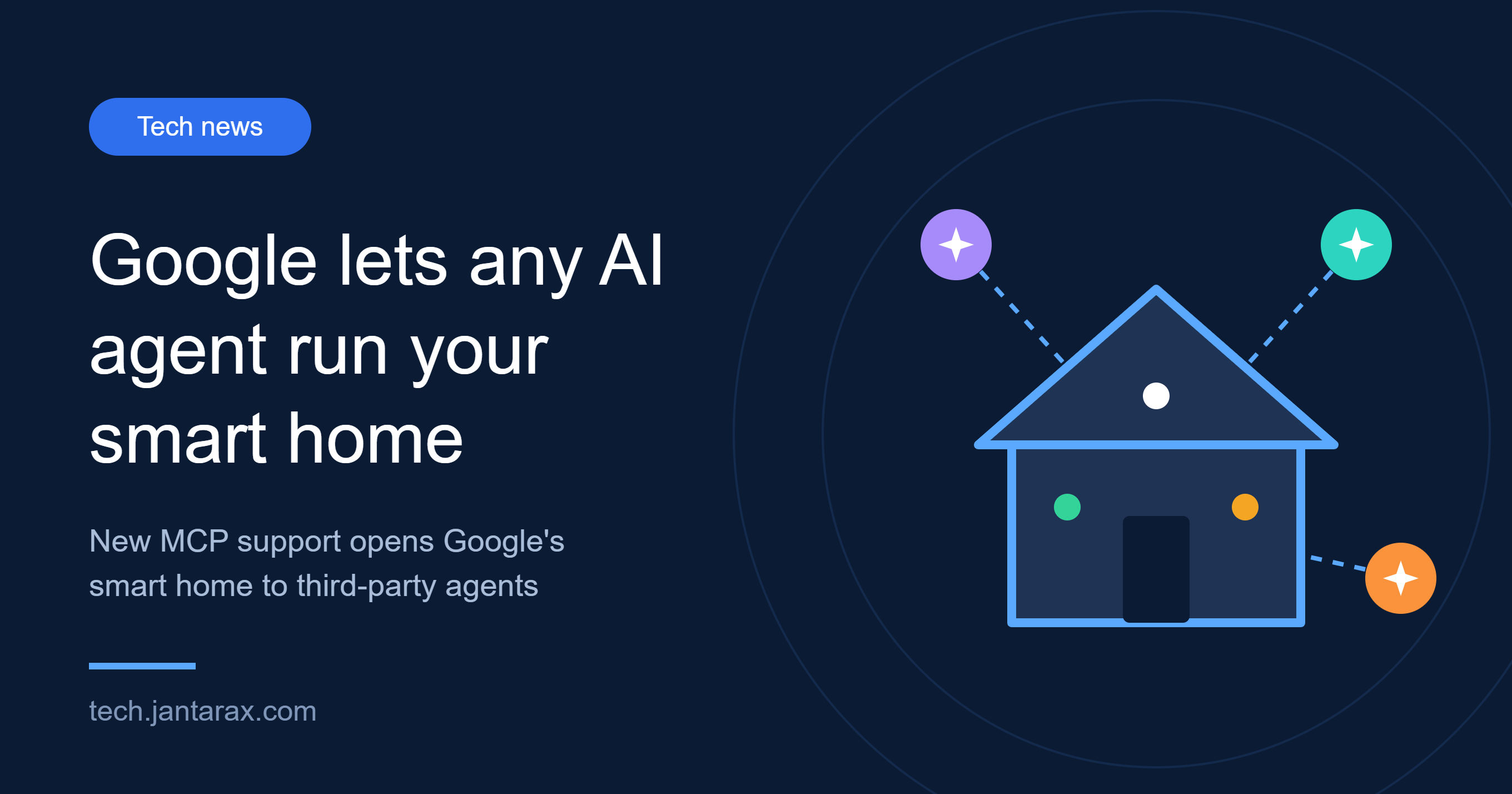
Google is opening up its smart home ecosystem in a big way. The company has announced that third-party AI agents, such as Claude and Open Claw, will be able to control and manage connected devices in your home. Instead of relying only on Google’s own assistant, you could soon pick the AI tool you prefer to run your lights, thermostat, and cameras.
Here is what Google announced, how it works, and what it could mean for your home. For more stories like this, browse our Technology and Gadgets coverage at Jantarax Tech.
What Did Google Announce?
Google’s new initiative allows outside AI agents to access and manage smart home devices through a shared standard. Until now, most smart home control has stayed inside a company’s own assistant and app. Google is changing that by letting the AI tool you already use talk directly to your connected devices.
The goal is more capable interactions. Rather than issuing one command at a time, you could ask an AI agent to handle a whole task, such as getting the house ready for the evening.
What Is the Model Context Protocol (MCP)?
The Model Context Protocol is a standard that defines how AI agents communicate with tools and services. Think of it as a common language. If a device or platform supports it, any AI agent that also speaks MCP can connect without a custom integration. MCP was first introduced by Anthropic, the company behind Claude, and has since been adopted widely across the AI industry. You can read about another recent Anthropic launch in our story on its free AI vulnerability scanner for open-source projects.
For smart homes, this means developers don’t have to build a separate connection for every device and every AI. One standard can cover many combinations.
Why Is Google Opening Up Its Smart Home?
The move fits a growing push toward interoperability, where devices and platforms work together instead of locking users in. By welcoming outside AI agents, Google positions itself to compete more effectively in a fast-moving smart home market.
It also reflects how quickly AI assistants are improving. As more people rely on AI tools for daily tasks, a smart home platform that works with them becomes more attractive than one that works with only a single assistant.
What Could AI Agents Do in Your Home?
Because the protocol is designed to standardize communication, the possibilities are broad. According to the announcement, the benefits could include:
- Smarter energy management. An agent could adjust heating, cooling, and lighting based on your habits and usage.
- Improved security. It could monitor cameras and sensors, and alert you when something looks unusual.
- Tailored automation routines. You could describe what you want in plain language and let the agent build the routine.
- Greater personalization. You choose the AI tool that fits your style, rather than the one your device maker picked.
Security and Privacy Questions
More access means more responsibility. Smart home devices hold sensitive information, including when you are home, what your cameras see, and how you use your space. Giving third-party agents control raises fair questions about permissions, data handling, and what happens if an agent is misused or compromised.
Data protection is a growing concern across the tech industry, as shown by the Revolut data breach caused by fake government requests. Our Cybersecurity section tracks stories like this. Debate over how much oversight AI needs is also active, including Nvidia CEO Jensen Huang’s argument against AI regulation.
What Happens Next?
As Google rolls out the feature, the key thing to watch is how third-party agents work with existing devices. Success will depend on:
- How robust the protocol is in real-world homes.
- Developer interest in building compatible AI tools.
- User feedback, which will help refine how these interactions work.
How to Prepare
You don’t need to change anything today, but a few habits will help:
- Keep your smart home devices and apps updated.
- Review which apps and services have access to your devices.
- Grant only the permissions an AI agent actually needs.
- Use strong, unique passwords and two-step verification on your account.
Frequently Asked Questions
Can any AI agent control my Google smart home?
Google says it will allow third-party agents, but they need to be compatible with the Model Context Protocol.
What is MCP in simple terms?
It is a standard way for AI agents to connect to apps, services, and devices.
Which AI agents are mentioned?
Claude and Open Claw are named as examples.
Is it safe?
Details on safeguards will matter. Review permissions carefully once the feature is available to you.
Conclusion
Google’s decision to let any AI agent run smart home devices marks a major shift in home automation. By embracing third-party AI tools, it gives users more choice and sets the stage for a more connected, intelligent home. The full impact will become clear as developers and users start exploring what is possible.
For more updates, learn about Jantarax Tech or contact our team with tips and feedback.
- Google AI agent smart home
- Google smart home
- AI agents
- Model Context Protocol
- MCP
- Claude
- Open Claw
- home automation
- smart home devices
- Google Home
- tech news