Who Is Rohit Patel?
Patel spent eight years at Meta working on AI, with a focus on reinforcement learning and on checking whether AI output can be trusted. Reinforcement learning is a method where AI systems learn by trial and error, improving as they are rewarded for good results.
His exit adds to a run of high-profile departures from Meta in recent months, as TechCrunch notes, including Joel Kaplan, Andrew Tulloch, and Emily Dalton Smith.
What Is Ndoc?
Ndoc is built around a common frustration. Many people jump between spreadsheets, word processors, slide software, dashboards, and AI chatbots, pasting results from one to another. Patel wants one shared workspace that replaces that patchwork. Colleagues can open the work even if they have not signed up.
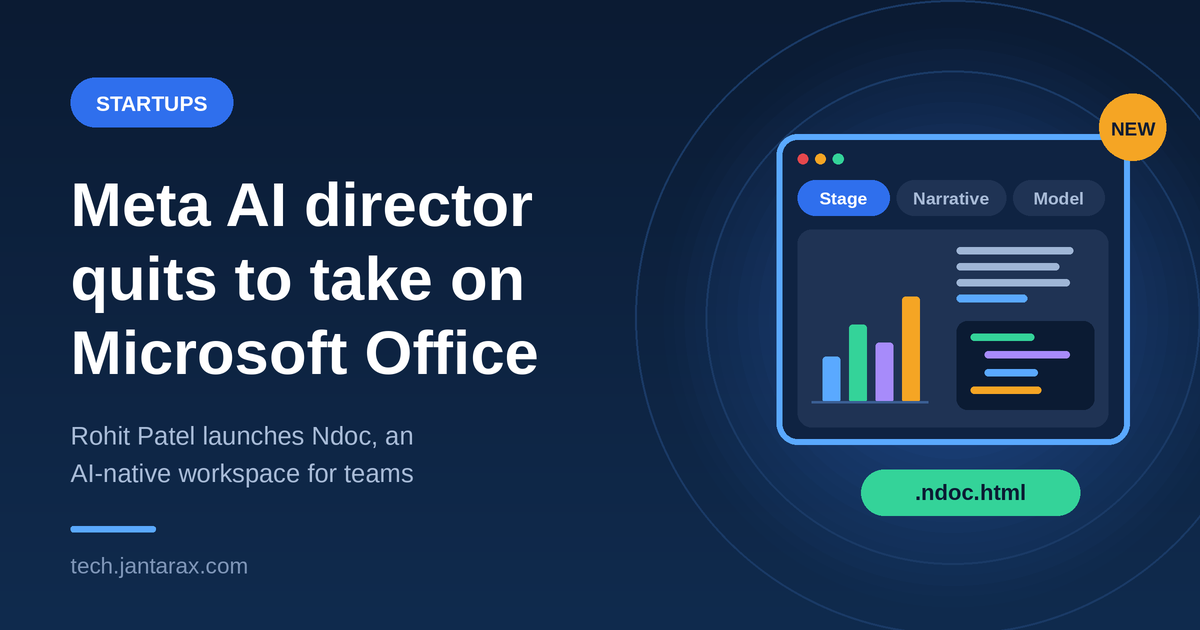
The workspace has three parts:
- Stage: where final results live, such as slide decks, dashboards, simulations, or small apps.
- Narrative: where the written analysis sits, with citations, generated charts, and the reasoning behind the numbers.
- Model: where the underlying data and Python scripts are kept.
Why “Show Your Work” Is the Big Idea
Patel’s background in evaluating AI shapes the design. His view is that if AI will build the spreadsheets and presentations companies use to make decisions, people must be able to check how it got there.
So in Ndoc, the scripts behind a document are visible. Even if you do not know Python, you can ask the built-in AI chat to explain what a script does or where a formula lives. Patel put it plainly: “There’s nothing hidden behind the curtain here.”
You can also upload a dataset and ask Ndoc to analyze it and write up the findings. Ndoc remembers context at several levels, including the person, the document, the team, and the company, and you can set the audience and tone for each document.
A Cheaper Way to Run AI?
Patel says Ndoc is built and fine-tuned on a mix of open-source models, not on top of the biggest frontier models. He claims this makes it much cheaper to operate. Interestingly, he says early users did not care much about that. What excited them was having the whole process, from data to final deliverable, in one place.
Rethinking the File Itself
Patel’s most ambitious goal is to change what a document is. Ndoc work can be exported as a single .ndoc.html file that opens in any browser. He plans to make the format open source so other developers can build tools around it without being locked into one company, as many users have been with Microsoft or Google.
That ambition was part of why he left Meta. He argues that getting a big company to agree on a new open format would involve countless opinions and slow everything down.
Why This Is a Tough Fight
Taking on Office and Workspace is a huge challenge for a three-person team with no funding. And the giants are moving too. OpenAI, Anthropic, Meta, Google, and others have launched AI tools that plug into existing work apps. OpenAI recently introduced a shared workspace inside ChatGPT called Space, which competes more directly with traditional suites.
Patel admits Space could be a threat, but he thinks the big labs are approaching the problem the wrong way by attaching AI to spreadsheets. In his words, it is like discovering electricity and using it to light up a plow instead of building a tractor.
There is a reason for the labs’ strategy. Habits are hard to change, and most people do not want to rebuild their workflows. Patel says he understands this, so Ndoc includes connectors that let users import data from tools they already use.
What Happens Next?
Ndoc is starting an enterprise pilot and opening a limited alpha to people on its waitlist. Signing up is free, but customers will pay for usage. Patel hopes to release a beta in the coming weeks and plans a full launch next year. He also says he held off on raising money until he had proof that people love the product.
Things to watch:
- Early user feedback from the pilot and alpha.
- Whether the open file format attracts other developers.
- How the big AI labs respond as they expand their own workspace tools.
- Funding news, which could change how fast the team can grow.
What This Means for Everyday Workers
Even if Ndoc never becomes a household name, the idea behind it matters. As AI creates more of our reports and analyses, being able to check how a result was produced will matter more. Small teams are already using AI to save time, as we covered in how small businesses are saving time with AI. Trust and transparency will decide which tools stick.
Trust is also at the center of the wider AI debate. Read our brief history of AI executives calling for regulation and our story on Anthropic’s free AI vulnerability scanner for open-source projects.
Frequently Asked Questions
Who is Rohit Patel?
A former director at Meta Superintelligence Labs who worked on AI evaluation and reinforcement learning for eight years.
What is Ndoc?
An AI-native workspace that brings analysis, writing, and presentations together and aims to replace tools like Microsoft Office and Google Workspace.
Is Ndoc available now?
It is starting an enterprise pilot and a limited alpha for people on a waitlist, with a beta expected soon and a full launch next year.
Is it free?
Signing up is free, but customers pay for usage and tokens.
What is the .ndoc.html format?
A single file that opens in any browser. Patel plans to open source it.
Conclusion
Rohit Patel’s move from Meta to Ndoc is a bold bet that the office suite is ready for a rebuild. With no funding, a tiny team, and giant rivals, the odds are long. But his focus on transparency and open formats offers a different pitch from the “AI added to your spreadsheet” approach. The coming months of testing will show if users agree.
For more updates, learn about Jantarax Tech or contact our team with tips and feedback.
- tech news
- data breach
- firewall VPN breach
- firewall breach
- VPN security
- Fortinet FortiGate
- Palo Alto GlobalProtect
- exposed credentials
- network security
- multi-factor authentication
- enterprise cybersecurity