If you use Chainstack, you need to act. If you do not, the incident still shows how fast attackers are moving. Here is what happened, what was exposed, and exactly what to do. For more security stories, explore our Cybersecurity section at Jantarax Tech.
Quick Summary
- Chainstack disclosed the breach on Tuesday, November 3, 2026.
- The attacker got in through a third-party component, then moved from a development environment into parts of production.
- Exposed data includes organization names, account holder names, member email addresses, and password hashes.
- The attacker also reached systems holding node credentials. Chainstack has no evidence they were read, but treats them as exposed.
- Customers should rotate node credentials, regenerate API keys, change passwords, and watch for phishing.
What Happened in the Chainstack Breach?
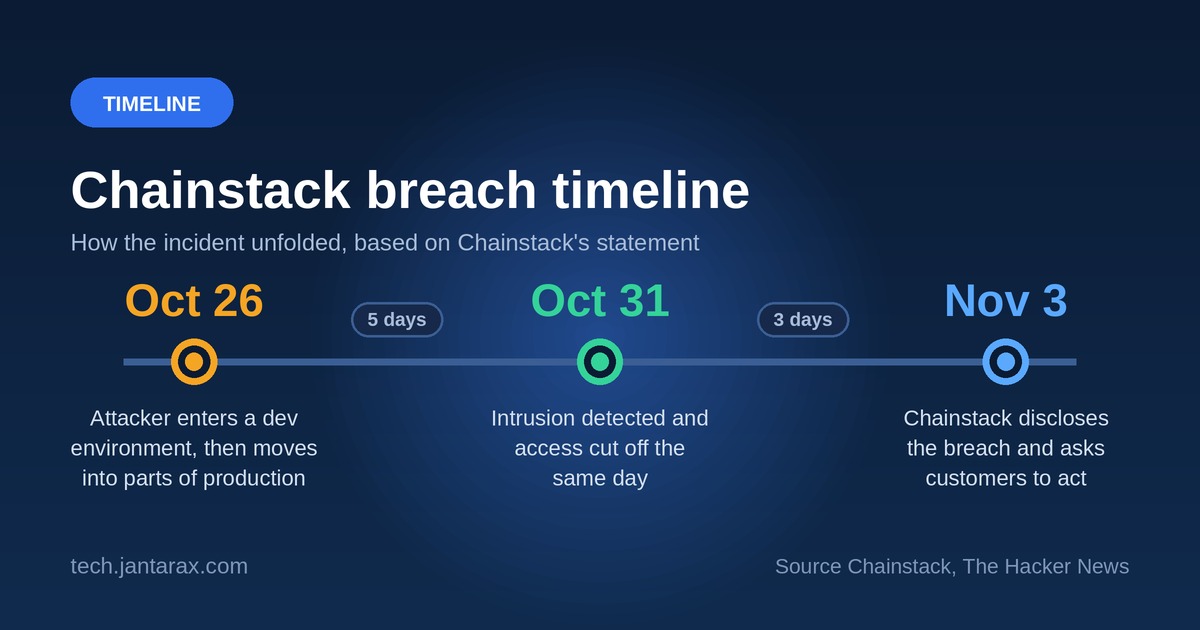
According to Chainstack’s timeline, the attacker first got into a development environment on October 26, 2026. From there, they escalated access into some parts of the production environment.
Chainstack detected the intrusion on October 31, 2026 and cut off the attacker’s access the same day. It announced the incident publicly on November 3. The company says the attacker used a third-party component to get in, and it summed up its response in one line: “We detected the intrusion, cut the access paths, and are hardening our systems.”
What Data Was Exposed?
Chainstack says the attacker accessed a database containing:
- Organization names
- Account holder names
- Email addresses of organization members
- Password hashes
The attacker also had access to systems that hold node credentials. The company says it has no evidence those credentials were read, but it is treating them as exposed and asking customers to rotate them.
Some outlets mention other details, but Chainstack’s own statement is the most reliable source. Read it for any updates.
What Is a Password Hash?
A password hash is a scrambled version of a password. Services store hashes instead of the real password, so a leak does not directly show what you typed.
Hashes still carry risk. Attackers can try to guess passwords offline and compare the results with the stolen hashes. Short, common, or reused passwords are cracked the fastest. Long, unique passwords are much harder to crack. The OWASP password storage guidance explains how services should protect hashes.
What Are Node Credentials?
Blockchain nodes are the computers that read from and write to a blockchain. Companies like Chainstack run nodes for customers, so apps can connect without managing their own servers. Node credentials, such as access keys or endpoint tokens, act like a login for that connection.
If someone else gets them, they might be able to use or abuse your node access. That is why Chainstack wants customers to replace them even without proof of misuse.
What Should Chainstack Customers Do Now?
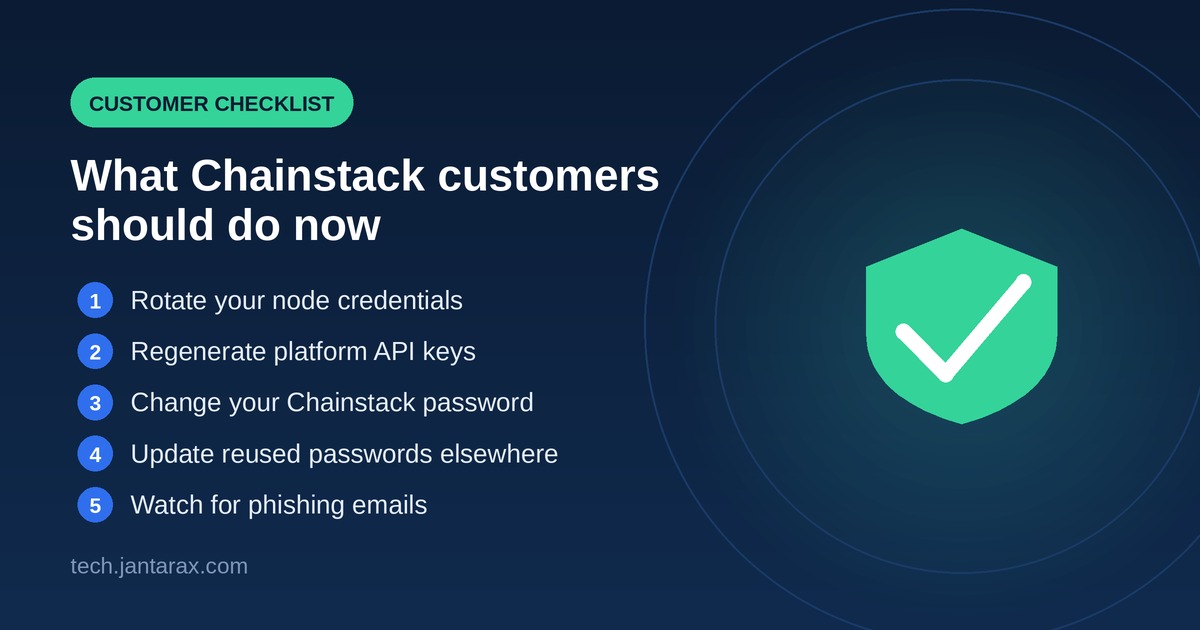
Chainstack has asked customers to take these steps. Do them in this order:
- Rotate your node credentials. Replace the old ones and update every app that uses them.
- Regenerate your platform API keys. Old keys should stop working.
- Change your Chainstack password. Choose a long, unique one.
- Change reused passwords elsewhere. If you used the same password on other services, update those too.
- Watch for phishing. Attackers may use leaked emails to send convincing fake messages.
Additional good practice, not from Chainstack’s statement:
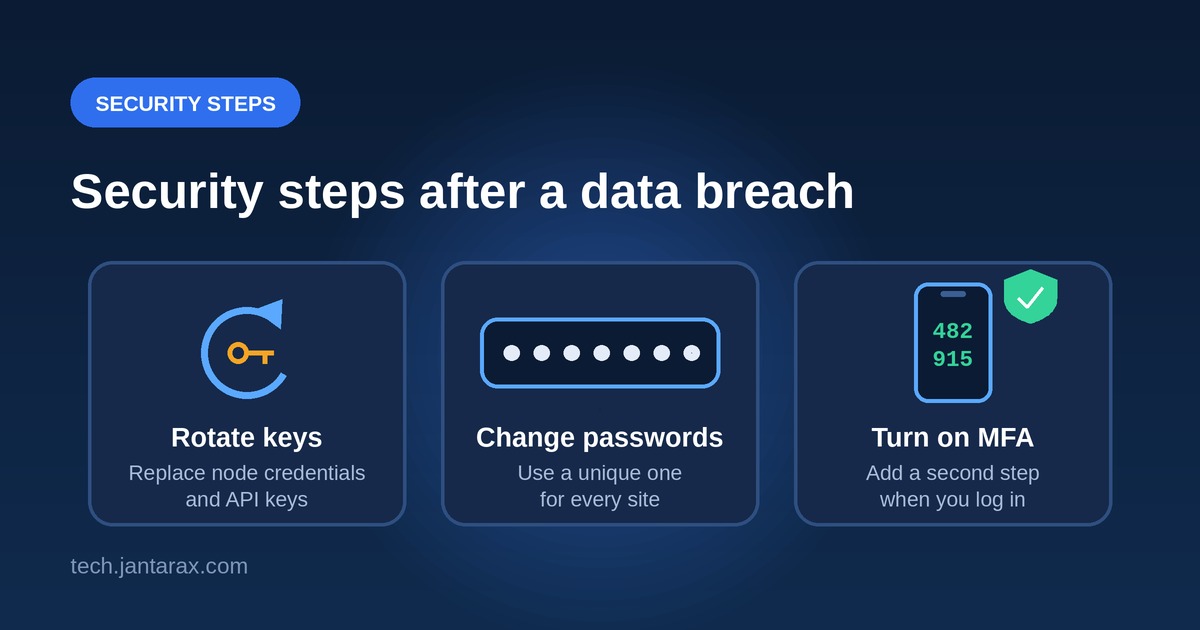
- Turn on multi-factor authentication wherever it is available.
- Use a password manager to create unique passwords.
- Review logs for unusual node usage or API calls.
- Store secrets in a secrets manager, not in code or chat.
- Give each key only the permissions it needs.
Was This an AI-Powered Attack?
Chainstack did not share attack specifics. But The Hacker News reports that the incident is assessed as part of a large-scale, AI-powered campaign that surfaced last week. It says the activity overlaps with a China-linked group using an autonomous AI agent framework called ARTEX, which has reportedly targeted more than 200 organizations worldwide. This attribution is an assessment, not a confirmed finding, so treat it with care.
Other organizations have reported similar incidents. API platform WorkOS said its sales-related systems were hit, but not production systems or customer platform data. Blockchain analysis firm Chainalysis said an outside actor used offensive agentic techniques to reach its systems and took two products offline as a precaution.
WorkOS warned that AI increases the speed and scale of attacks that exploit exposed apps and stolen credentials. In practice, attackers can automate steps that once took people hours.
Why Does This Matter Beyond Chainstack?
Attackers go after the infrastructure. Companies that sit behind many apps, such as blockchain providers, are valuable targets because one breach can reach many customers.
Third-party components are a weak link. Chainstack says the attacker got in through one. Every company relies on outside software, so supply chain security matters.
Development environments are not harmless. Here, access to development led to production. Test systems need the same care as live ones.
Password reuse spreads damage. One leaked hash can threaten many accounts if you reuse passwords.
Recent breaches show the pattern, including the Revolut data breach caused by fake government requests. Defenders are also adopting AI, such as Anthropic’s free AI vulnerability scanner for open-source projects. Our Artificial Intelligence section follows how AI is changing both attack and defense.
What Happens Next?
Chainstack says it is hardening its systems and investigating. Watch for:
- A fuller incident report on the third-party component and the exact data touched.
- Confirmation on whether any node credentials were actually used.
- Updates from related victims and investigators about the wider campaign.
- Phishing attempts that mention Chainstack.
Frequently Asked Questions
What happened to Chainstack?
An outside attacker reached parts of its infrastructure, including production systems and a customer database.
What data was exposed?
Organization names, account holder names, member email addresses, and password hashes. Node credentials were also accessed, though Chainstack has no evidence they were read.
Were my passwords leaked in plain text?
The reports mention password hashes, not plain-text passwords. Hashes can still be cracked, so change your password.
When did the breach happen?
The attacker accessed a development environment on October 26, 2026. Chainstack detected and blocked it on October 31 and disclosed it on November 3.
What should I do if I use Chainstack?
Rotate node credentials, regenerate API keys, change passwords, and watch for phishing.
Was the attack powered by AI?
It is assessed as part of an AI-powered campaign, according to The Hacker News. Chainstack has not given specifics.
Conclusion
The Chainstack breach is a reminder that blockchain providers face the same threats as any technology company, and that attackers are speeding up with AI. If you are a customer, rotate your credentials and change your passwords today. If you run a service of your own, treat third-party components and development systems as part of your attack surface.
- tech news
- data breach
- password hashes
- Chainstack
- Chainstack data breach
- node credentials
- blockchain security
- AI-powered cyber attacks
- ARTEX
- API keys