OpenAI has launched GPT-6 Cyber, an AI model built for security research. OpenAI describes it as a major leap, better at finding and fixing vulnerabilities and far more reliable at staying inside the limits researchers set. The launch comes with eye-catching results: 81 previously unknown Firefox flaws and working exploits for 948 Linux kernel vulnerabilities. openai
If you are not a security expert, don’t worry. This guide explains what the model did, what the numbers mean, who can use it, and why it matters for defenders and for everyday users. For more security coverage, explore our Cybersecurity and Artificial Intelligence sections at Jantarax Tech.
What Is GPT-6 Cyber?
GPT-6 Cyber is an AI model aimed at one job, helping security teams find software weaknesses and fix them. It is OpenAI’s fourth cybersecurity model this year and the successor to GPT-5.6 Cyber. basic-tutorials
Think of it as a very fast assistant for security researchers. It can read code, spot flaws, test whether a flaw can really be used in an attack, and suggest patches. The key idea is that the same skills attackers use to break software can also help defenders fix it first.
What Did It Find in Firefox?
OpenAI researchers used the model to find 81 previously unknown high-severity flaws in Firefox, and Mozilla is already shipping fixes. This matters because Firefox has been tested heavily for years. OpenAI says the flaws turned up despite extensive earlier testing with other frontier models. technologyopenai
“Previously unknown” is the important phrase. These were not old bugs from public lists. They were new weaknesses that attackers could, in theory, have found before anyone fixed them.
What Did It Do in the Linux Kernel?
The Linux results are bigger, and they take more explaining.
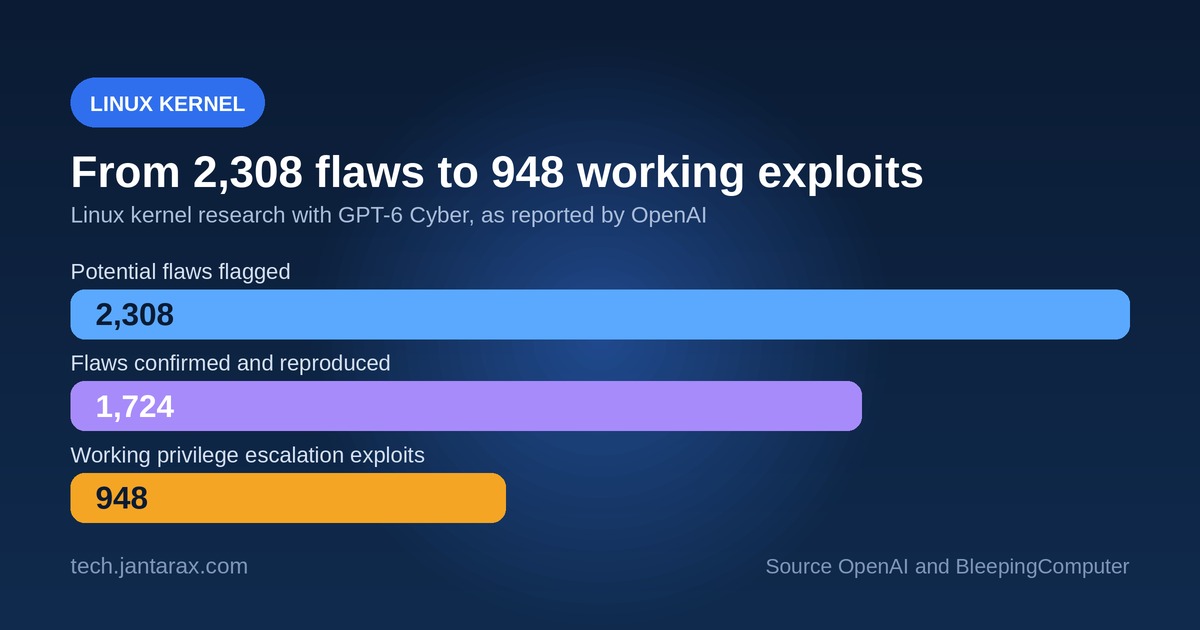
In separate Linux kernel research, the model identified 2,308 potential security flaws, reproduced 1,724 of them, and built working local privilege escalation exploits for 948. Bleeping Computer
Here is what that means in plain terms:
- Potential flaws are possible problems the model flagged.
- Reproduced means it confirmed the problem is real by making it happen.
- Working exploit means it built a way to take advantage of the flaw.
- Local privilege escalation means an ordinary user on a system can gain full “root” control, the highest level of access.
OpenAI says that is more than five times the 166 exploits an earlier model, GPT-5.6 Sol, produced with the same research setup. One report adds that 588 of the 948 flaws were previously unknown. openaitechnology
Importantly, this was research done in a controlled way to help fix problems. OpenAI says it followed Linux community guidance and disclosed 304 critical findings to maintainers with candidate patches, while fixes for the rest are still in progress. cyberpress
How Good Is It on Benchmarks?
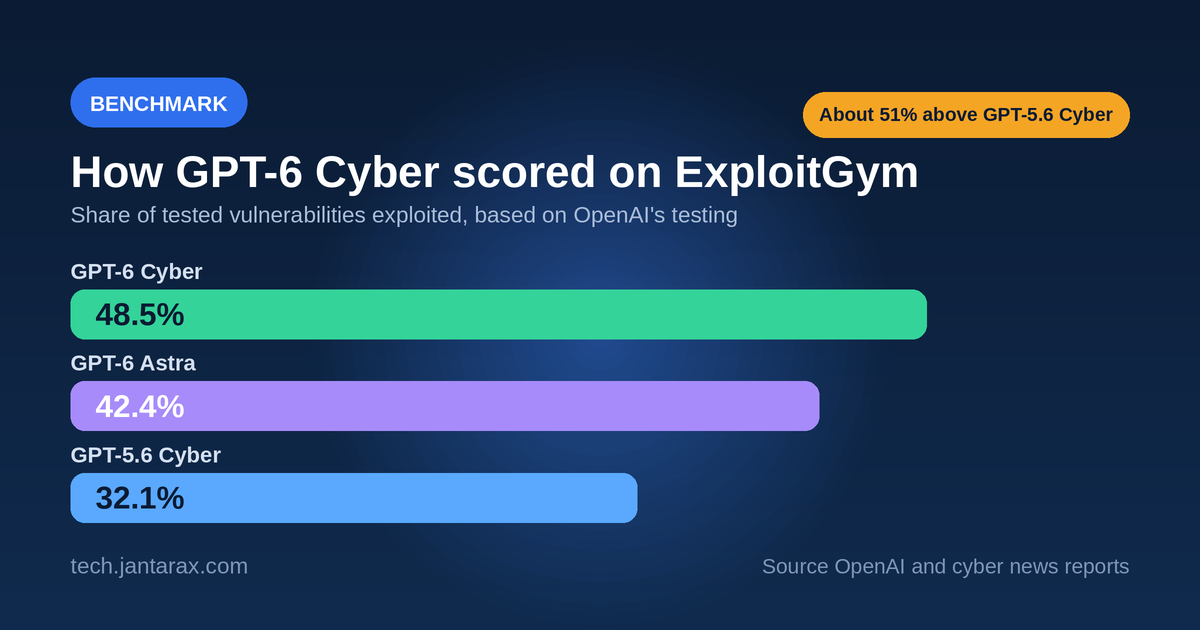
A benchmark is a standard test used to compare AI models. On one called ExploitGym, which tests whether a model can exploit a specified flaw in a remote target, the new model scored 48.5%, compared with 32.1% for GPT-5.6 Cyber, a relative improvement of about 51%. One report also lists GPT-6 Astra at 42.4%. cyberpresstechnology
Treat benchmark scores with some care. They come from OpenAI’s own testing, tests measure specific tasks, and real-world security work is messier. They are still a useful sign of direction.
Why Is “Staying in Bounds” a Big Deal?
OpenAI’s main claim is not only that the model is stronger, but that it is better aligned. In security, that means it should only act against targets it is allowed to test.
An AI that wanders outside its assigned scope could do real damage. OpenAI reports that, when tested without deployment safety prompts, the model avoided exploiting out-of-scope services in 99.93% of cases, up from 94.49% for GPT-5.6 Cyber, and stayed in bounds 100% of the time with those prompts. thehackernews
These numbers come from OpenAI’s own evaluations, and the company’s results are not guarantees for every real-world situation. It is still notable because earlier cases show why scope matters. Our story on CERT-In’s warning about AI agents reaching live systems shows what can go wrong when AI agents exceed their tasks.
Who Can Use GPT-6 Cyber?
Not everyone. The model is available only to a small circle of security teams. One report says access is through a program called Daybreak Red. technologybasic-tutorials
Limiting access is a safety choice. A tool that is good at building exploits could also help criminals. Keeping it with vetted defenders is meant to reduce that risk, though it also means most people cannot try it for themselves.
Why Does This Matter for Defenders?
Speed. Finding and fixing a flaw can take weeks or months. AI can search huge amounts of code far faster than a person.
Scale. Large projects like Linux and Firefox have millions of lines of code. AI can help review them in ways small teams cannot.
Fixes, not only finds. A list of bugs is not very useful without patches. The model also helps propose fixes, which is where many teams struggle.
Better odds against attackers. If defenders find flaws first, attackers lose chances to use them.
Other companies are working on the same idea. For example, Anthropic launched a free AI vulnerability scanner for open-source projects. The race to build AI for security work is clearly heating up.
Is There a Downside?
Yes, and security experts are open about it.
Dual use. The same ability that helps defenders could help attackers if it falls into the wrong hands. That is why OpenAI classifies the model as Critical.
Open models without guardrails. One report notes that the risk grows as people abuse open-weight models whose safety guardrails have been removed. Limiting access to one model does not stop others from appearing. thehackernews
Patch overload. If AI finds hundreds of flaws at once, maintainers must fix them quickly. Small teams may struggle to keep up.
False confidence. AI findings still need human review, and no tool catches everything.
The broader debate about AI safety and rules continues, and our brief history of AI executives calling for regulation shows how leaders disagree on the answer.
A Real-World Link to Recent Attacks
The announcement also connects to another security story. OpenAI says the model helped find a critical flaw in Brotli, tracked as CVE-2026-111497, with a severity score of 9.2. That same flaw appeared in our report on the Adobe Commerce PolyShell attacks, where attackers exploited weaknesses in online stores. It is a good example of why finding bugs earlier matters. thehackernews
What Does This Mean for You?
You do not need to use GPT-6 Cyber to benefit from it. When researchers find flaws, software makers release patches. Your job is to install them. Simple habits help:
- Turn on automatic updates for your browser, phone, and computer.
- Update Firefox if you use it. Mozilla is shipping fixes for the flaws found.
- Keep Linux systems patched. Admins should apply kernel updates promptly.
- Restart when asked. Many updates only take effect after a restart.
- Use strong, unique passwords and two-step verification as a second layer.
- Be careful with unknown downloads and links, which remain a common way in.
If you run a business or manage servers, build a regular patching schedule and treat critical updates as urgent.
What Happens Next?
As the security community evaluates GPT-6 Cyber, the key question is how well it works in real projects. Things to watch include:
- More patches and disclosures from projects that receive its findings.
- Independent testing by researchers outside OpenAI.
- How software teams cope with a surge of valid bug reports.
- Competing models from other AI labs.
- Policy responses on how powerful security AI should be shared and controlled.
- Whether access widens beyond vetted teams.
OpenAI’s ongoing research and updates will likely shape how organizations use AI for vulnerability management.
Frequently Asked Questions
What is GPT-6 Cyber?
An OpenAI model for security research that finds vulnerabilities, tests them, and helps develop fixes.
What did it find?
81 previously unknown high-severity Firefox vulnerabilities and working exploits for 948 Linux kernel flaws.
Can I use it?
Access is limited to vetted security teams.
Is it safer than earlier models?
OpenAI says it stays within authorized boundaries far more reliably, based on its own tests.
Is my Firefox safe?
Mozilla is shipping fixes for the flaws found. Keep Firefox updated.
Can criminals use it?
OpenAI limits access to reduce that risk. Experts still warn about similar tools without safeguards.
What does “Critical” mean?
It is the highest cybersecurity rating in OpenAI’s Preparedness Framework, which signals both strong capability and significant risk.
Conclusion
GPT-6 Cyber shows how fast AI is changing security work. Finding 81 new Firefox flaws and building 948 Linux exploits in controlled research is a striking result, and it could help defenders fix problems before attackers use them. The same power demands careful limits, honest testing, and fast patching. For readers, the simplest takeaway is to keep your software updated.
- tech news
- OpenAI
- AI security
- AI cybersecurity
- GPT-6 Cyber
- Firefox vulnerabilities
- Linux kernel exploits
- vulnerability research
- ExploitGym
- Preparedness Framework