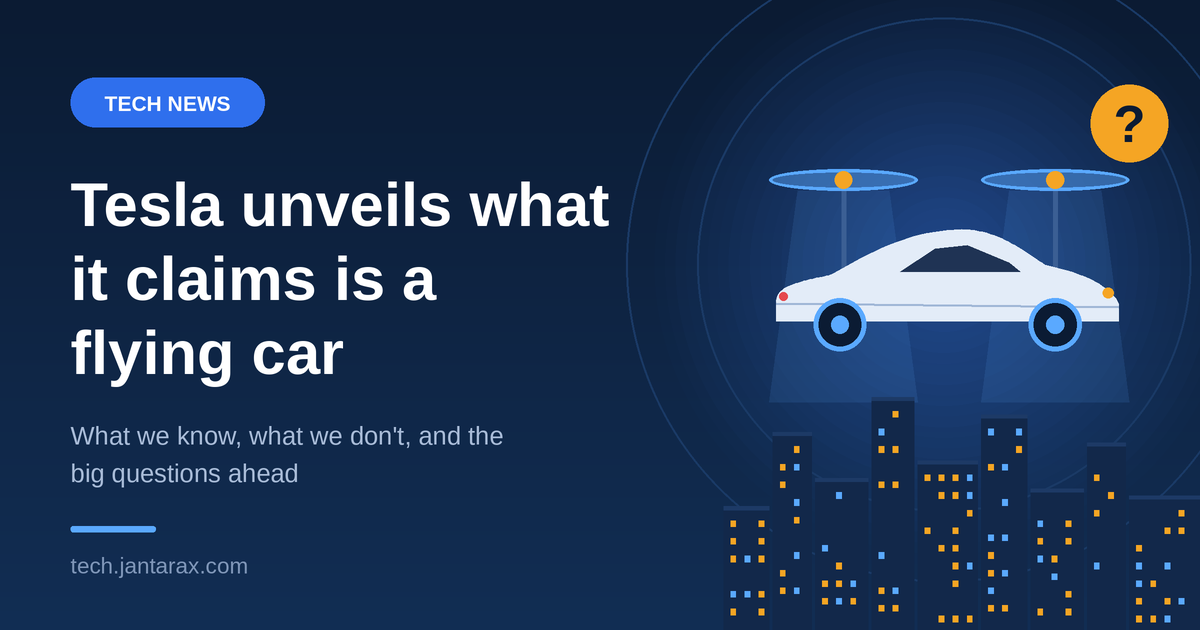
Tesla has shown what it describes as a flying car, and the tech world is paying attention. The announcement revives a decades-old question: are flying vehicles a real part of the future, or just an exciting idea?
Here is a clear, simple look at what Tesla showed, why it matters, and the challenges that remain. For more stories like this, explore our Technology and Gadgets sections at Jantarax Tech.
What Did Tesla Unveil?
According to reports, Tesla presented a flying car prototype at a recent event. The company framed it as part of its ambition to change personal transportation.
The vehicle is said to combine advanced aerodynamics with electric propulsion. Tesla’s stated aim is to offer a new way to travel that could ease traffic congestion in busy cities.
Early reports suggest the vehicle may use Tesla’s existing battery technology. Beyond that, the details are limited, so it is wise to treat many of the claims as unproven for now.
What We Still Don’t Know
Tesla has made bold claims, but key specifics have not been fully disclosed. Open questions include:
- Design: What does the final vehicle look like, and how does it fly?
- Capabilities: How far can it travel, how fast, and with how many passengers?
- Timeline: When could it go into production, if at all?
- Price: Who could afford one?
Until Tesla shares these details, it is hard to judge whether this is a practical product or an early concept.
Are Flying Cars Really New?
No. The idea of a flying car has been around for decades. In recent years, many companies have worked on eVTOL vehicles, which are electric aircraft that take off and land vertically, like a helicopter, without needing a runway.
These designs are usually quieter than helicopters and run on batteries. The main goal is faster travel over short city distances. If you want background on this fast-growing field, see our earlier look at Tesla’s Roadster flying demo vs eVTOL rivals.
What makes Tesla’s entry notable is its reputation. The company is well known for electric vehicles and for pushing technology forward, so its involvement draws far more attention than a typical startup would.
Why Could This Matter for Cities?
If flying cars worked well, they could change how people move around cities:
- Less traffic: Some trips could move into the air, easing crowded roads.
- Faster trips: Travel times for short and medium distances could shrink.
- Cleaner transport: Electric power may reduce emissions compared with fuel-based aircraft.
These are potential benefits, not guarantees. Much depends on whether the technology proves safe and affordable at scale.
The Big Challenges
Flying cars are a contentious topic because major hurdles remain.
Safety. A car that fails stops on the road. An aircraft that fails falls from the sky. Flying vehicles will need extremely high safety standards, proven reliability, and strong backup systems.
Regulation. Aviation authorities have strict rules for aircraft, pilots, and airspace. A vehicle that works as both a car and an aircraft raises new questions that lawmakers have not fully settled. Our Policy section follows how rules for new technology take shape.
Infrastructure. Flying vehicles need places to take off and land, charging points, and ways to manage traffic in the air. Cities do not have this today.
Public acceptance. Many people are skeptical. Noise, privacy, and everyday safety concerns will all shape whether communities welcome flying vehicles overhead.
Security. Connected vehicles run on software, which means cyber risks matter too. Read more in our Cybersecurity coverage.
What Happens Next?
As Tesla continues developing its prototype, industry experts and consumers will be watching closely. The company will need to handle regulatory hurdles and public doubt while proving its vehicle is safe and practical.
Things to watch include:
- Official details from Tesla on design, range, and production plans.
- Live demonstrations that show the vehicle actually flying.
- Regulator responses about how such a vehicle could be approved.
- Reactions from rivals in the eVTOL industry.
Future announcements and demonstrations will be crucial in deciding whether this project can move from concept to reality.
How to Read Big Tech Claims
When a company calls something a breakthrough, a few simple habits help:
- Look for independent verification, not just company statements.
- Check whether there is a working demo, not only a presentation.
- Watch for dates and specifics, which show how serious a plan is.
- Remember that a prototype is not a product.
Frequently Asked Questions
Did Tesla really unveil a flying car?
Reports say Tesla showed a flying car prototype. Many details have not been confirmed.
When can I buy a Tesla flying car?
There is no confirmed production timeline.
Is a flying car the same as an eVTOL?
They are closely related. An eVTOL is an electric aircraft that takes off and lands vertically. Flying cars may use similar technology.
What are the biggest obstacles?
Safety, regulation, infrastructure, and public acceptance.
Conclusion
Tesla’s flying car marks a notable moment in transportation technology. The excitement is real, but so are the doubts, and it is important to look at such claims with a critical eye. The coming months will be key in showing whether this idea can become a practical part of city life.
For more updates, learn about Jantarax Tech or contact our team with tips and feedback.
- tech news
- flying car
- eVTOL
- air taxi
- electric vehicles
- Tesla flying car
- Tesla
- urban mobility
- aviation regulation
- future transport